Wandering chimp photographed in the Mahale Mountains National Park, Tanzania, AfricaBy Emma Reynolds
..This is the moment an adorable baby chimp took his first faltering steps away from his mother.
His beard and wrinkles belying his tender years, the brave youngster looked a little unsteady on his feet as he determinedly approached the camera in a bid to show off his confidence.
But his courage soon faded and he fled back to the safety of his family.

Brave explorer: The tiny chimpanzee wobbles slightly as he tries to look tough for the camera
 Growing up: The young animal is clearly keen to become independent, left, but is still deeply reliant on his doting mother, right
Photographer Konrad Wothe captured the sweet little chimp making his first forays out into the big wide world in the Mahale Mountains National Park, Tanzania, Africa.
The 59-year-old's incredible, close-up shots reveal the true depth of the wide-eyed baby's heart-warming relationship with his family.
In one photograph, the youthful chimp appears to smile as he is cradled in his devoted mother's arms.
In another, he cautiously eyes the camera while sticking close to his parent's side.
Mr Wothe, from Munich, Germany, was delighted to be able to photograph the young chimp from such close quarters.
He said: 'As soon as the babies reach the age of six months they start to explore and leave the safe body of the mother and climb in the trees.

Nuts to this: Konrad Wothe photographed the little chimp at the Mahale Mountains National Park, Tanzania, Africa
 I'd kill for a banana: The toddler relaxes with his mother in these rare and revealing close-up shots
'This baby was trying to intimidate me with short attacks, but before it reached me it ran back to mum and showed me grimaces.
'Within six days with the chimps I only had one close encounter with the baby and I was happy to get such nice shots.'
He added: 'You are lucky to find a female group of chimps and even more if they have a small baby among them.
'Each tourist or photographer has a limited time the apes. You are only allowed around an hour per day.
'The best time to see them is when they're on the ground. If they're up in the trees, it's very difficult to photograph them.'
source:dailymail

•Amusing spectacle is photographed by Daniel Parent in Ottawa, CanadaBy Graham Smith
This greedy chipmunk appears to have bitten off more than he could chew when he dug into a pile of nuts.
The animal had been among a group of eight that had been given the nuts to share.
But it seemed he was keen to wolf down as much food as possible.

Feeding time: A hungry chipmunk is chock full o'nuts in western Ottawa, Canada
 Comedy cheeks: The chipmunk had been among a group of eight that had been given the nuts to share
Amused onlookers watched as the chipmunk gorged until his cheeks were puffed up to comedy proportions.
And just when it seemed he'd had enough, he returned for a second helping.
Daniel Parent photographed the extraordinary spectacle in western Ottawa, Canada.
The 51-year-old, an insurance worker from Quebec, said: 'About eight chipmunks congregated on the peanuts.
'Some appeared to be quite greedy and stuffed their mouths, creating this amusing photo opportunity.
'I wasn't counting but I think some chipmunks easily got two peanuts in to their cheeks, some of the more ambitious tried to get more.'

Amused onlookers watched as the chipmunk gorged until his cheeks were puffed up to comedy proportions
 That's more like it: The extraordinary spectacle was photographed by Daniel Parent in western Ottawa, Canada
He added: 'Normally the animals would just grab a peanut and leave but the one pictured tried to take as many as possible while protecting the stash.
'It could have been because there were lots of nuts and lots of rival chipmunks.
'After stuffing his cheeks, he ran off to store his stash and then returned to get more. He only stopped when all the food had gone.
'I have never seen a chipmunk with his cheeks that full before. Normally they only take one at a time.
'They are such cute creatures and it was just so funny to watch them. People who have seen these images just love them.'
source:dailymail
By Leon Watson
The photographer gingerly places a small, mixed-breed puppy on a platform in his makeshift studio at an animal shelter in northern Taiwan.
The dog looks around two months old, with alert, trusting eyes and a shiny coat. It has no owner and will not get one.
Once its photo shoot is over, it will be taken away by vets to be put down.

In a makeshift studio, Taiwanese photographer Tou Chih-kang tries to make a portrait of a puppy in the final moments of its life before being put down by lethal injection at a shelter in Taoyuan, northern Taiwan

A dog sits in a cage behind his paperwork before being put down by lethal injection at a government-run shelter in Taoyuan
 Tou calms a puppy before trying to make a portrait in the final moments before it is to be put down by lethal injection
Tou Chih-kang has been recording the last moments of canines at the Taoyuan Animal Shelter for two years.
He has captured the images of some 400 dogs, most of which were pets abandoned by their owners. To him the work is distressing, but he's trying to spread a message of responsibility.
'I believe something should not be told but should be felt,' says Tou, a thick-bodied 37-year-old with an air of quiet confidence.
'And I hope these images will arouse the viewers to contemplate and feel for these unfortunate lives, and understand the inhumanity we the society are putting them through.'
His photographs are similar to the formal portraits - of people - that were taken 100 years ago, designed to bestow dignity and prestige upon the subject before death.
In many of the dog portraits, the animals are placed at angles that make them look almost human.

Death row: Tou Chih-kang hangs his portraits of the final moments in the lives of shelter dogs for a public exhibition - Tou has been visiting dog shelters for two years now

Tou greets a dog scheduled to be euthanised later in the day: He photographs in hopes of educating the public on the proper care of pets
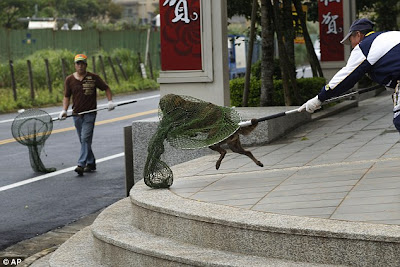 A government dog catchers ensnare a dog on the streets of Taoyuan: The animal will likely be next for the injection
This year Taiwanese authorities will euthanise an estimated 80,000 stray dogs. Animal-welfare advocates say the relatively widespread nature of the phenomenon - Taiwan's human population is only 23 million - reflects the still immature nature of the island's dog-owning culture and the belief among some of its majority Buddhist population that dogs are reincarnated humans who behaved badly in a previous life.
It would seem, judging by the many stores in Taiwan that sell fancy dog clothes and other baubles, as if Taiwanese fawn over their animals, and some do. But others abandon pets to the streets once their initial enthusiasm cools.
'Animals are seen just as playthings, not to be taken seriously,' says Grace Gabriel, Asia regional director of the Massachusetts-based International Fund for Animal Welfare.
Activists say that some 70 per cent of dogs in Taiwanese shelters are killed after a 12-day waiting period, despite government efforts to find them homes. Gabriel says dogs in U.S. shelters are less likely to be euthanised, though millions of cats continue to be put down there each year.

This year Taiwanese authorities will kill an estimated 80,000 stray dogs at 38 pounds scattered throughout the island

Waiting to die: A dog begs for attention at a government-run shelter in Taoyuan
 Paws for thought: One more picture of a dog destined to die
The dogs who wind up in Taoyuan are picked up by roving patrols, funded by local governments, of workers equipped with large nets.
The dogs come in all sizes and shapes. Some are young and active, others grizzled, listless and battered. After Tou photographs them, veterinary workers take them for a brief turn around a grassy courtyard before leading them into a small, clinical-looking room where they are killed by lethal injection.
Tou, who uses the professional name Tou Yun-fei, says he began his project because the Taiwanese media were not paying enough attention to the dogs' plight. He says he doesn't believe in having pets, but the problem had long plagued his conscience.

Tou has made more than 400 human-like portraits over the last two years

Taiwanese photographer Tou Chih-kang hangs his portraits of the final moments in the lives of shelter dogs for a public exhibition in Taoyuan
 Sleeping dogs: A nurse prepares the room used to euthanise dogs
He says that while some of his friends refuse to even look at his photographs, others say the images taught them to take pet ownership more seriously.
A handful of the some 40,000 dog pictures Tou has taken are due to be exhibited this August in his first full-scale show, at the Fine Arts Museum in the southern Taiwanese city of Kaohsiung.
A few photos already are on display at Taoyuan city hall, part of a bid to raise citizens' awareness of the responsibilities that come with raising a pet.
'I am a medium that through my photography, more people will be aware of this issue,' he says. 'I think that's my role.'

Choosing his portraits: Tou identifies dogs on a manifest that are to be killed later that day

The leashes of dogs put down that day hang from a metal fence outside one of the city's shelters
source:dailymail
Posted in
News update
By Daily Mail Reporter
This daring cat was banking on its nine lives to survive.
The fearless feline jumped to safety from a Las Vegas apartment complex engulfed in flames.
Miraculously, no one was killed in the fire, and the cat walked away unharmed. In total, three adult residents and a fire battalion chief were injured; a dog was not so lucky and perished in the fire.

Inferno: This grey and white cat was trapped on a second-storey balcony at a Las Vegas apartment complex

Weighing my options: The fire blasts away both windows to the screen doors; the cat appears to think about jumping on the roof
 Jumping to safety: The cat springboards off the balcony and lands safely two storeys below
The incredible video, captured by KLAS-TV in Las Vegas, shows the Sonoma Shadows Apartments consumed by flames.
A grey and white cat suddenly leaps up from the balcony. A raging fire has completely engulfed the apartment behind and breaks first the left, then the right windows of the sliding door.
The cat looks frantically around – to the side, to the roof, to the ground below – and is unsure where to go. The roof appears to high to scale, and would likely be too hot.
There was nowhere else for the panicked moggy to go.
After looking around for several moments to determine the best escape route, the cat places its front paws over the wooden railing to leap to the ground, two storeys below.

Fierce fire: Around 50 apartments were destroyed in the blaze; here, firefighters try and quench the flames
 Not good clean fun: Authorities warn against using fireworks, as many people's worldly possessions were lost
Those recording the feat are yelling, encouraging the cat to jump to safety. ‘Jump, baby, jump!’ one man yells hoarsely.
With one powerful leap, the cat kicks out from the balcony and flails before falling to the ground below.
According to KLAS-TV, the cat was unhurt. Unfortunately, a dog in the apartment complex was not as lucky, and perished in the blaze.
The station notes that three people, including Gregory Sutton, who helped save his mother and pregnant girlfriend, who was due to give birth in about a week.
He suffered some third-degree burns on his shoulder, but brushed it off, saying: ‘My health was the last thing on my mind.’
Investigators believe that the fire was started by fireworks. In total, 50 residences were destroyed.
The Red Cross is assisting those who have lost their homes in the fire.
source:dailymail
•First panda born in Japan in 24 years and first ever to be conceived naturally in the country
•Prior to its birth it caused political scandal as Japanese governor suggested naming it after disputed islands both Japan and China lay claim to
•As with all giant pandas in captivity outside China the baby and its mother Shin Shin is on loan and will eventually be returnedThese heartwarming pictures show seven-year-old mother Shin Shin cuddling her new-born at Ueno Zoo in Tokyo.
The people of Japan are celebrating the first baby panda born in the country in 24 years.
The birth was captured on night vision webcam and a video was quickly released by Ueno Zoo showing Shin Shin giving birth and holding the tiny baby to her chest.

Love and care: Shin Shin cuddles her newly born baby holding the cub close to her chest
The sex of the cub, born on Thursday, has not yet been determined.
It is the first panda to be born after being conceived naturally in Japanese history.
The task is extremely difficult task as female pandas are only in heat for 72 hours over the entire year and can only become pregnant during a 24 hour slot.
In the wild female pandas normally have a cub every two or three years.
 The unnamed cub is too young to have gained the characteristic black marks and its size is not living up to the name of Giant Panda
The unnamed baby panda caused a stir even before it was born.
When it was announced last week that Shin Shin was pregnant Japanese governor Shintaro Ishihara suggested Shin Shin’s baby be named Sen Sen or Kaku Kaku – a wordplay on the disputed Senkaku Islands which are part of Japan but are claimed by both Taiwan and China.
 He got a quick response from Chinese Foreign Ministry spokesman Hong Lei regarding the islands, known to the Chinese as the Diaoyu.
Speaking at a press conference in the capital last Friday he said: ‘Ishihara’s scheme to undermine China-Japan relations is a clumsy performance. It will only tarnish the image of Japan and Tokyo,’
‘No matter what names the Japanese side gives, it cannot change the fact that the two pandas belong to China.
‘Likewise, what names Japan gives to the Diaoyu Island and the adjacent isles, it cannot change the fact that these islands belong to China.’
The zoo's panda team, comprised of five workers and four veterinarians, will continue using two cameras to observe the pair 24 hours a day for about a week, and have been joined by a breeding expert from Sichuan, China, where Shin Shin grew up.
Visitors to the zoo eager to see the baby will be disappointed as Ueno Zoo, which is the oldest in Japan, has expressed wishes to keep the cub and mother away from the public for another six months.
Shin Shin and her mate, Ri Ri, are on loan from China for 10 years.
Under the terms of the agreement between Japan and China, the cub will be sent back in two years.

Just the two of us: The cub is the first to be born in Japan in 24 years and will no be displayed to the public for six months
source: dailymail
Posted in
News update,
Panda
By Simon Tomlinson
Like a band of brothers, these humpback whales are so close they hunt in near-perfect unison.
By cleverly blowing air at depths of 600ft, they create a bubble net that traps their prey near the surface.
Then with the grace of synchronised swimmers, the 35-tonne giants break waves at just the right time to devour the fish.

Feeding time: Three humpback whales rise in tandem to gobble up a school of fish after blowing bubbles to trap them just under the surface of the Pacific off Alaska

Air snare: By cleverly blowing air at depths of up to 600ft using their powerful lungs, the humpbacks can create masses of bubbles which confuse and trap their prey
 Keeping their trap shut: The whales close their mouths as they sink beneath the surface with lunch well on the way to their stomachs
With whales needing to consume around 3,000lbs of food a day, it is essential they work as a team to corral as many fish as possible.
Photographer Jon Cornforth caught the feeding session in the waters of Frederick Sound in the north east Pacific Ocean, near Alaska.
As winter turns to summer, humpback whales travel from the warm coast of Mexico to the northern waters off Alaska to feed on fish such as salmon that are returning to their spawning grounds in huge numbers to breed.

Teamwork: With the whales needing to consume around 3,000lbs of food a day, it is essential they work as a team to corral as many fish as possible

Open-mouthed: The 35-tonne giants make sure they break the surface at exactly the same time to ensure they snare as many fish as possible before they can escape the bubble net

Capturing the action: Photographer Jon Cornforth caught the feeding session in the waters of Frederick Sound in the north east Pacific Ocean, near Alaska

Predatory instinct: As winter turns to summer, humpbacks travel from the warm waters off Mexico to Alaska to feed on fish such as salmon that are returning to their spawning grounds in huge numbers to breed

Rising up: Despite their huge size, they exhibit the grace of synchronised swimmers to go with their cunning tactics, proving themselves fearsome predators

Making a song and a dance: One whale certainly seems happy about this latest meal. Humpbacks can weigh two tons at birth and grow to more than 45ft and 40 tons when full size

Impressive: Humpbacks can dive for up to 45 minutes, reach depths of 600ft and blow out air from their blowholes at speeds of 300mph
 Each to their own: Their lungs can hold 2,500 gallons of air and each whale can be identified from the unique marking on the underside of its tail
Humpbacks can weigh two tons at birth and grow to more than 45ft and 40 tons when full size.
They can dive for up to 45 minutes, reach depths of 600ft and blow out air from their blowholes at speeds of 300mph. Their lungs can hold 2,500 gallons of air. Every humpback can be identified from the unique marking on the underside of its tail.
Once under threat from whaling ships, thanks to laws protecting them the humpback whale population is now increasing each year, with current world numbers estimated to be more than 60,000.

Five-course meal: Feeding time for these hungry giants stretches until sunset. Each whale needs to consume around 3,000lbs of food a day

On the rise: Once under threat from whaling ships, new laws are helping to preserve and even increase world numbers of humpback whales, currently estimated to be more than 60,000
source:dailymail
By Daily Mail Reporter
These cute and cuddly Chinese panda cubs are giving their carers the real run around.
Endearing footage shows the four friendly black and white beauties slipping and sliding down a custom-made wooden slide.
Living at the Chengdu Panda Base, dedicated to saving and breeding giant pandas and other rare animals, at times they act like little kittens.
Scroll down to see the video...
Cute: The fabulous footage shows the four pandas slipping and sliding down the slide

Squealing: Emitting cute noises, the pandas role on their backs as they tackle the obstacle
 All fours: This panda looks like he's having a whale of a time as he plops off the end of the slide
Emitting tiny squeals of delight as gravity pulls them down to the ground, they follow in the footsteps of their human keepers by playing on the equipment.
And they seem infinitely more active than their former zoo-mates Yang Guang and Tian Tian, who arrived at Scotland's Edinburgh Zoo for a 10-year conservation project on December 4 last year.

Pile-up: The pandas charge onto the slide and fool about at the bottom, pushing some of them over the edge

Hugs: It's a real scrum to try and get onto the slide, shown by these hilarious pictures
 Chilling out: It's no surprise this panda has to have a rest after his exertions with his friends
The aim was for the pair to mate and breed, thus saving a species that is in rapid danger of soon becoming extinct.
But so far natural sparks have failed to fly between the couple and they remain panda cub-less.
VIDEO: Panda playtime! See the cute cuddly bears take their turns on the slide!...
source:dailymail
Posted in
News update,
Panda

 Growing up: The young animal is clearly keen to become independent, left, but is still deeply reliant on his doting mother, right
 I'd kill for a banana: The toddler relaxes with his mother in these rare and revealing close-up shots


