By Tamara Cohen
Three of the rarest turtles in the world have washed up on British beaches.
They were dragged thousands of miles from their normal habitats in warmer waters by stormy weather.
The two young Kemp’s ridleys and one green turtle died because of the cold after being blasted off course by massive currents during storms in Scotland earlier this month.

Rare: One of the young Kemp's Ridleys which was found washed up on British beaches - because massive currents were caused by storms in Scotland earlier this month
The Marine Conservation Society has warned more are likely to be discovered over Christmas and the New Year and urged the public not to put them back into the water.
While the first three have died, any others may just appear dead because the effect of the cold water initially puts them into a type of coma and they could be nursed back to health by experts.
The first young turtle discovered after the heavy storms two weeks ago – which saw power cuts and a wind turbine set on fire – was a young Kemp’s ridley, one of the smallest species of marine turtles.
The critically endangered warm water turtles nest on just a few beaches around the Gulf of Mexico. The turtle pictured above was found dead on the Isle of Tiree, in Scotland’s Inner Hebrides.
A few days later another washed up dead on a beach at Llanon, in West Wales. It was only the 37th seen on UK shores since records began in 1740.
 Storm victim: The green turtle found dead in Orkney
Then a green turtle – believed to have been blown off course from warmer waters near the Azores – was found dead on a beach in the Orkney Islands. It is believed to have been washed up alive, but died later.
Green turtles are also endangered and live mostly in the tropics, although nesting populations are found in Florida and in the Eastern Mediterranean.
Both kinds of turtle normally live in water warmer than 20c.
Dr Peter Richardson, biodiversity manager at the Marine Conservation Society, said: ‘They shouldn’t be here but when we get heavy weather like we did this month – with some hurricane-type winds in the North – they get blown in.
‘Once they are in the cold waters they do not function very well and they can’t swim against the currents.’
source:dailymail
Posted in
News update,
Turtle

By DAILY MAIL REPORTER

Siamese turtle owner fears operation to separate pets
The owner of two conjoined turtles is trying to decide whether to have the animals separated.
Todd Ray - owner of what is thought to be the world's largest collection of double headed animals - was given the turtle by a concerned California man, after it became listless and was hardly moving.
Speaking to the Huffington Post, owner Todd Ray said: 'I got a phone call from a kid near Compton whose grandfather has turtles.
'The man had two conjoined turtles and the boy wanted to try and save them.
'I told him how to hydrate them and told him to give them time to eat, because one head will claw the other one in front of him, not realizing they can't get away.'
The man was not sure what to do, and feared the turtles may die.
Mr Ray added: 'They weren't moving. They are very little, maybe about six weeks old, and when I first saw them, they were motionless. But I grabbed one of the legs and it pulled back.
'This is the very first time I have ever wanted to separate two animals.
'That would be a tough separation because they both need a plastron. It is not something that will grow back.'
source: dailymail
Posted in
News update,
Turtle
By SEAN POULTER

Victim: Sea turtles are among the endangered species killed by plastic bags
It is a beautifully simple plan in which everyone wins.
Shoppers are charged 5p each for plastic bags, raising £50million a year for charities and cutting the number of bags issued by 90 per cent.
Sadly, at the moment it is only going to happen in Wales. The scheme will be introduced on October 1 with the backing of all political parties.
 Danger: A Pacific Green Turtle suffocating on a plastic bag after mistaking it for a jellyfish
The Government has been urged to roll out the idea across Britain and provide a lifeline for thousands of charities whose existence is threatened by savage funding cuts.
James Allen of the National Council for Voluntary Organisations, which represents 8,500 charities, said: ‘We know that plastic bags create unnecessary waste.
 Banish the bags: The Daily Mail's 'Banish the Bags' campaign, launched in 2008, has been pushing for efforts to tackle the waste
source: dailymail
Posted in
Bird,
News update,
Turtle
By DAILY MAIL REPORTER

Tough cookie: Andre, a 171-pound green sea turtle, is almost ready for his scheduled release
When Humpty Dumpty is said to have fallen off the wall, they couldn't put him together again.
But luckily it was a different story this turtle who had his shell pieced back together after it was shattered into tiny pieces.
 Procedure: Humpty has his shell repaired by Mr Vargas at the Palm Beach Loggerhead Marine Life centre with a laser gun normally used on people's teeth
The turtle - who has been dubbed 'Humpty Dumpty - was found with massive cracks in his shell after being hit by a motor boat propeller. There was even a crab living inside one of the cavities.
Animal rescuers at the Palm Beach Loggerhead Marine Life Centre spent 13 months putting poor Humpty back together again.
The turtle is now fit and strong enough to return back to the wild after his thick shell was repaired with teeth braces in the first procedure of its kind.
 Cracked: Dr. Nancy Mettee cleans Humpty's wounds before special materials are implanted into the shell for it to be reconstructed
Orthodontist Alberto Vargas - who had the bizarre job of reshaping Humpty's 171-pound shell - said the sea turtle was of the strangest patients he had ever dealt with.
'I'm not aware of this ever being done on a turtle before,' Mr Vargas told the Palm Beach Post.
'We changed the shape of his shell, just like we change the shape of a patient's jaw.'
The 12-stone turtle was found in June 2010 with two large life-threatening propeller holes gouged its shell.
 Healed: Andre was found in June 2010 with two giant holes in his shell from two separate boat propellers
source: dailymail
Posted in
News update,
Turtle
By Daily Mail Reporter
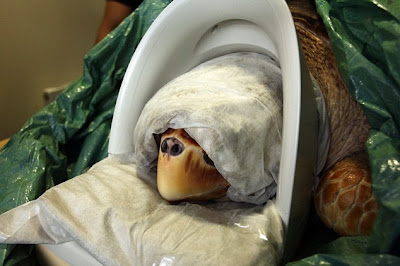
Snorkel prepares for her session in an MRI scanner to see if she has a brain tumour
This is Snorkel, a Loggerhead Turtle, which made a 320-mile round trip for an MRI scan over fears that she has a brain tumour.
The sick reptile is a star attraction at the National Marine Aquarium in Plymouth, but five after five years of suspected epileptic fits have raised questions over her health.
Sue Thornton, from the International Zoo Veterinary Group said scans at the Cobalt Centre, in Cheltenham, would help to determine whether or not Snorkel has a brain tumour.
 Workers operate the machine as vets work to find out if she has epilepsy after five years of fitting
She is currently being given doses of anti-epilepsy medication twice a day to control her fits.
If a tumour was found, however, Mrs Thornton said some 'very difficult decisions' would have to be made dependent on the results of the scan.
'It is in her best interest to have this scan and we will do everything we can to reduce any stress that she will experience,' she said.
James Wright, from the National Marine Aquarium, said she is a firm favourite with many visitors and they would do everything to keep her healthy and happy.
She was rescued in 1990 after having been found washed up in Sennen Cove, Cornwall.
Due to ill health she has spent the last 10 years being cared for at the National Marine Aquarium.
 Star attraction: Snorkel is among the favourites of visitors to the National Marine Aquarium
source:dailymail
Posted in
News update,
Turtle
By Mail Foreign Service

Washed ashore: Sea Biscuit has learned to dive and swim like normal creatures after being rescued as a hatchling found on a beach in 2009
When Sea Biscuit lost her left flipper, it could have been a turtle disaster.
But thanks to her human friends at Oceanworld Manly in Sydney, the little battler is now diving and weaving gracefully through water.
The green sea turtle could fit in the palm of a hand when he was rescued after washing up on a beach as an exhausted hatchling in 2009.
 On the crest of a wave: Flipperless green sea turtle Sea Biscuit is able to swim and dive again after a two-year rehabilitation programmed in Manly, Australia
Sea Biscuit’s infected flipper had to be amputated and it had taken him a long time to gain weight and strength.
'She had been through quite a big ordeal for such a small turtle,' said handler Marina Tsamoulos.
The turtle had to be painstakingly encouraged in her marine enclosure.
'We rehabilitate with the hope we can release them back into the wild,' Ms Tsamoulos said.
'Sea Biscuit has recovered but she is still growing ... she will stay in Oceanworld for now, but that will be reviewed in the future.'
Green sea turtles spend their formative years drifting on ocean currents, grow to four-and-half feet and weight more than 47 stones. They live an average 80 years in the wild.
 Restored to health: Sea Biscuit swims past handler Marina Tsamoulos in the tropical reef aquarium at Oceanworld Manly, north of Sydney
source:dailymail
Posted in
Turtle
By FIONA MACRAE

Jagged pieces of plastic can cause fatal internal damage to turtles by perforating organs and causing a blockage in the bowels.
They look like the pieces of a colourful mosaic.
But these shards of plastic were found in the stomach of a young sea turtle that lost its battle against the rising tide of pollution.
Environmental campaigners say the image illustrates the deadly toll that our throwaway culture is having on marine life.
Sea turtles are prone to mistaking plastic bags for jellyfish, one of their favourite foods.
The plastic can block the digestive tract, leading to a slow and agonising death from starvation.
The juvenile green sea turtle that consumed this haul of plastic was found off the coast of Argentina. Adults can grow up to 44ins long.
 Harmful: This collection of hundreds of coloured, jagged shards was found in sea turtle's stomach
In the latest issue of the Marine Turtle Newsletter, biologists said up to 75 per cent of green sea turtles examined had eaten plastic debris.
One was found to have swallowed items including four types of balloon, a piece of carpet-like material and two tar balls.
The report’s authors, Colette Wabnitz of the University of British Columbia and Wallace Nichols of the California Academy of Sciences, said: ‘The bodies of almost all marine species, including some of the most vulnerable and wildest species on the planet – animals that make nearly their entire living far from humans – now contain plastic.
source: dailymail
Posted in
Science and Tech,
Turtle
By DAILY MAIL REPORTER

Incredible journey: A baby loggerhead turtle carries one of the specially adapted 9gram satellite tags as it sets off on its epic journey
Scientists have lifted the lid on an incredible 70-day journey that wild turtles, some younger than six months old, take for the first time.
Researchers tagged some of the smallest and youngest ever baby turtles to be tracked, revealing the epic 4,500 mile journey in the Atlantic Ocean.
The young Loggerhead turtles were monitored by satellite as they made their journey - the equivalent of travelling from London to Mumbai.
Scientists customised the 9gm tracker tags normally used for birds, making them waterproof, before gluing them onto the reptiles' shells.
Jeanette Wyneken and Kate Mansfield, from Florida Atlantic University, said they were amazed at the length of the journey made by the 17 tiny turtles.
'This is the first time turtles aged four months have ever been tagged and tracked by satellite,' said Dr Wyneken.
'Previously we have never known what these young turtles do once they leave their beach nests and swim off into the ocean.
'It was important to us that the tags did not stop them from behaving normally. Thankfully they acted as as if there was nothing attached to there backs at all.
'Seaweed is an important habitat for the turtles and they had no problem moving around it.'
 Dr Jeanette Wyneken snorkelling with a juvenile loggerhead sea turtle. It is hoped the research can help identify areas that need protecting
Using data transmitted by the tags, the team was able to map every movement.
Dr Wyneken said: 'The turtles varied a lot in their movements, more so than we expected. They're likely doing much more than just paddling straight to the deep water and riding the current.
'We're very happy and excited by the results.'
The 17 satellite tags cost £32,000 and allowed the animals to be monitored from anywhere on the planet.
 The 17 satellite tags cost £32,000 and allowed the animals to be monitored from anywhere on the planet. Researchers now know that their movements vary a lot more than they thought
The little loggerhead turtles were captured from their Florida beach nests especially to take part the tagging project.
The hand-sized reptiles were between four and six months old when they were released 10-miles east of Palm Beach and weighed only 300 grams.
When they are between six and eight months of age they outgrow the tags which fall off into the sea.
'We're trying to protect them from harm,' said Jeanette.
 4,500 miles: This map of Florida shows the routes taken by five of the turtles on their epic 70 day trip into the North Atlantic Ocean
'The question is one of basic natural history: where are they going? For how long and what are the risks in between?
'If you don't know where they are or what places they're visiting you don't know what areas you need to protect.
'And if you don't have this information you're gambling with the method you're using to protect them and enhance their survival.'
Funding for the project came from the University of New Hampshire's Large Pelagics Research Center, Save Our Seas Foundation, Disney Worldwide Conservation Fund, and the Florida Sea Turtle Licence Plate Grants Program.
The full results of the tracking are expected to be published later this year.
source: dailymail
Posted in
Science and Tech,
Turtle
By DAILY MAIL REPORTER

Turtle tourists: A U.S attorney's office photo shows turtles that were confiscated Los Angeles International Airport after a foiled smuggling attempt
More than 50 endangered creatures caught in 'Operation Flying Turtle'
Two Japanese men have been arrested at Los Angeles International Airport after attempting to smuggling more than 50 live turtles into the U.S.
The men, both from Osaka, were arrested on Friday at LAX as part of a investigation into live animal smuggling known as 'Operation Flying Turtle'.
The pair had hidden turtles and tortoises in snack food boxes inside a suitcase and could face up to 21 years in prison if convicted.
Atsushi Yamagami, 39, and Norihide Ushirozako, 49, both Japanese citizens, are charged in a two-count criminal complaint that alleges one count of illegally importing wildlife into the United States, a smuggling offense that carries a statutory maximum penalty of 20 years in federal prison.
The men are also charged with one count of violating the Endangered Species Act, a misdemeanour that carries a statutory maximum penalty of one year in prison.
The pair were part of a smuggling ring that officers working with Operation Flying Turtle had infiltrated in recent months.
 Snack-based smuggling: The turtles were concealed in small sacks hidden inside biscuit and cracker boxes
The U.S. Postal Service, U.S. Customs and Borders Protection and the Immigration and Customs Enforcement department's Homeland Security Investigations were all involved in Operation Flying Turtle, which began last year after U.S. Fish and Wildlife agents learned of a live animal smuggling ring.
'In August 2010, Hiroki Uetsuki, an associate of Yamagami and Ushirozako, traveled from Osaka, Japan, and arrived at Honolulu International Airport,' where turtles were discovered in his suitcase, prosecutors said.
'After U.S. Fish and Wildlife agents arrested Uetsuki, he informed the agents that Yamagami paid him approximately 100,000 yen ($1,200) and his travel expenses to smuggle turtles and tortoises into the United States,' officials added.
 Tiny visitors: A U.S. Attorney's Office photo confirms the diminutive size of the smuggled turtles
Claude Arnold, special agent in charge for ICE's Homeland Security Investigations in Los Angeles, added: 'The plundering and smuggling of rare plants and animals to satisfy the desires of hobbyists is not only shameful, in some circumstances it can pose a threat to public safety and the environment.'
Yamagami and Ushirozako's smuggling attempt, which saw Chinese big-headed turtles and Indian star tortoises, among other variants, packed inside cookie and cracker boxes, was one a number of bizarre attempts at concealment at LAX in recent years.
A man was charged with smuggling in 2002 at the airport after attempting to sneak birds of paradise, orchids and pygmy monkeys - the latter inside his underwear - into LAX, while another attempted smuggler was charged last year with trying to get through the airport with 15 live lizards attached to his chest.
source: dailymail
Posted in
News update,
Turtle
By DAILY MAIL REPORTER

Shell shock: The lemurs assess the situation as the turtle blocks the bridge
What do you get when you cross a lemur with a turtle? A leap-frog.
These hungry jokers faced something of a dilemma when they encountered the slow-moving turtle blocking the bridge leading to their feeding den.
Each of the fluffy ring-tailed lemurs tentatively approached the turtle before turning back - unsure how to negotiate the obstacle.
 High-tailing it: One of the lemurs gets up close as the turtle makes a U-turn to scare him away
Then, after gathering in a huddle to discuss their options, the one with the most courage broke away from the group and made a flying leap.
Following his brave lead, the others all followed - with the bemused turtle turning its neck to watch.
Local photographer Cindy Bendush, 52, snapped the 'mission' at Indianapolis Zoo in Indiana, United States.
She said: 'The lemur exhibit contains about a dozen lemurs, a variety of birds and a few turtles. It is one of the most entertaining exhibits at the zoo.
 Over the top: The lemur shows his courage and decides to make the jump
'The turtle was blocking the bridge that leads to the lemurs' indoor habitat. I started taking shots and within minutes one of the lemurs strolled about half way out towards the turtle, stopped and turned around.
'Upon returning to the island, a group of five or six began to gather. They seemed to be having a debate about how to handle the turtle and whether or not to cross the bridge.
 High flyer: That wasn't so bad after all as the lemur prepares to land
'Singly or in a small group they ventured out and back several times before one of them decided to jump. Once one started jumping, several others joined in.
'The lemurs certainly did not want to touch the turtle and not one harassed it in the least.
'They were wary but possibly making a game of it. I doubt this was the first time the turtles and lemurs have squared-off.

In fact he quite enjoyed it... and jumped back the other way
'They were still jumping back and forth when we left - Mr Turtle stood his ground.'
Cindy added: 'It was entertaining - even comical - to watch them problem solve and go about working up the courage to start jumping as a means to cross the bridge.
'It was almost as if they were daring each other to make the first jump.'
source: dailymail
Posted in
Lemurs,
Turtle
By DAVID DERBYSHIRE

Are we there yet? Leatherback sea turtles travel thousands of miles for anything up to 150 days to reach feeding and breading grounds
They are famed for their epic voyages across the world's roughest oceans.
But until now, nobody quite appreciated just how good leatherback turtles were at navigation.
In a new study, British scientists have discovered that the gigantic females can swim for thousands of miles in a perfectly straight line.
Following a course that would be the envy of a state-of-the-art cruise liner, the turtles make the transatlantic journey from Central Africa to South America using the shortest possible route.
 Inbuilt sat-nav: Scientists from Exeter University have now discovered that these amazing creatures are able to make their long journeys traveling the shortest possible route - often swimming in a perfectly straight line
Exactly how turtles can swim in a straight line remains a mystery to biologists.
However, they are thought to use a combination of vision - relying on the position of the stars and sun - and a sense of the Earth's magnetic field, to steer their way.
 Fancy a dip? Leatherbacks spend almost their entire lives in the water. The only time they leave their watery sanctuary is when they are nesting or when hatchlings, like this little fella, emerge from their nests
The findings come from a study led by the Centre for Ecology and Conservation at Exeter University.
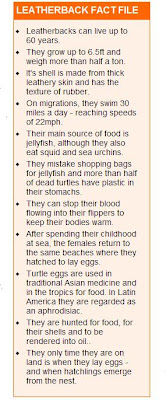 Over five years, the researchers tagged 25 females with satellite tracking devices strapped or drilled to their shells as they left their hatching grounds in Africa to seek food across the Atlantic.
They discovered three migratory routes - including one 4,699 mile journey straight across the Atlantic from Gabon to the coastal waters off southern Brazil and Uruguay that took 150 days.
Dr Matthew Witt, who published the findings in the journal Proceedings of the Royal Society B, said: 'Despite extensive research carried out on leatherbacks, no-one has really been sure about the journeys they take in the South Atlantic until now.
'What we’ve shown is that there are three clear migration routes as they head back to feeding grounds after breeding in Gabon, although the numbers adopting each strategy varied each year.
'We don’t know what influences that choice yet, but we do know these are truly remarkable journeys – with one female tracked for thousands of miles travelling in a straight line right across the Atlantic.'
 A map of the three routes taken by migrating turtles. Group 2, made up of leatherback turtles, travelled in a straight line
source: dailymail
Posted in
Science and Tech,
Turtle
 Rare: One of the young Kemp's Ridleys which was found washed up on British beaches - because massive currents were caused by storms in Scotland earlier this month
 Storm victim: The green turtle found dead in Orkney


