
Just the two of us: Kali the cheetah and puppy, Mtani have become close friends
While most cats and dogs couldn't stand being in the same room together for five minutes, roommates Kasi and Mtani are inseparable.
Thanks to their introduction a young age, four-and-a-half-month-old cheetah Kasi has found a friend for life in the form of a nine-month-old Labrador called, Mtani.
The pair were put together soon after Kasi was rejected by his mother at birth.
The animals' carers at Busch Zoo in Tampa, Florida, hand-picked Mtani from a local rescue centre to ensure the then four-week-old Kasi had a companion to grow up with.
'Male cheetahs are social and often live together in coalitions.
 Kali attempt to get Mtani's attention, and below, succumbs to his mate's advances to play together
'This social bond will be a very similar relationship, and they will be together for life,' said Tim Smith, one of Busch Gardens' animal curators.
After being rejected by his mother at birth, Kasi needed round-the-clock care to ensure his survival.
Soon after his arrival at Busch he was introduced to sixteen week old Mtani, and their friendship has blossomed ever since.

Despite coming from warring tribes, the pair are never happier than when frolicking together in the enclosure they share at the zoo.
Twice a day the unlikely due are brought out for visitors to see completely oblivious to the interest in their living arrangements.
'Kali and Mtali live together in our new cheetah run habitat. They love to play together; Mtali will chase sticks and Kali will try to steal it away from her.
'They love chasing each other around and play fighting. They are very curious, especially of the people looking at them through the glass,' said Jill Revelle, a Busch Gardens spokesperson.
Cheetahs are considered to be an endangered species and around 12,400 exist in the wild.
source: dailymail
Posted in
cheetahs,
Dog,
News update

By DAILY MAIL REPORTER

Jump around: The bruising encounter was a harsh lesson for the younger cheetah, challenged by the older male
The fur is literally flying in this extraordinary set of photos when a fight erupts among a group of cheetahs.
One of the cats leaps four feet in the air during the remarkable confrontation between two males.
The bruising encounter was a harsh lesson for the younger cheetah, who had been challenged by the older male.
The youngster was given a rough ride as its mother stood back with his sister - a sign that she wanted her son to take care of himself.
British photographer Elliott Neep captured the moments the family of three were approached by the cheetah, in Ngorongoro Crater Conservation Area, in Tanzania.
 High jump: One of the cats leaps 4ft in the air during the dramatic confrontation between two males
Elliott, 36, from Wantage, in Oxfordshire, said: 'We spotted three cheetahs resting in the shade.
'They were not settled and seemed very agitated. Their body language told me that something was wrong.
'Then, in the shade of a nearby tree just a few feet away, we could see a fourth cheetah.
'We tried to figure out what was happening but it was not clear. A young cheetah rose from the ground and immediately, the cheetah under the tree pounced and lashed out at him.
'The youngster flipped onto its back in a state of submission and the big male leapt over.
'As soon as the big male moved, I started firing the shutter. I just had a sudden instinct that a fight was imminent.
 Take that: The encounter unfolds, including the high-jumping cheetah leaping in the air
'The situation quickly unravelled and the scene became clear. This was an adult male attempting to push out a female's full-grown cubs to mate.
'After the dust settled, the big male came face to face with the youngster and began sounding a long drawn-out meow.
'It was similar to the sound two domestic cats make when they have a territorial dispute in the garden.

Fur flying: The youngster was given a rough ride as its mother stood back with his sister - a sign that she wanted her son to take care of himself
'The young male began to chirp to its mother for support. But she did not intervene - for me, a clear sign that she had finished raising them and it was time for them to leave.' He added: 'We left with the four cheetahs still grouped together, but exhausted and tired under the midday sun.
'The sequence looked great on the camera and had a massive grin on my face.
'When I reviewed it later on the big screen, the grin was even wider as I could now see the fur literally flying when the cheetah was in mid-air.'
source :dailymail
Posted in
cheetahs,
News update
By DAILY MAIL REPORTER

Cuddly: The cheetah being reared at Busch Gardens animal theme park in Florida
It looks like a cute baby cheetah, but it sounds like a bird.
The cuddly five-week old cub has yet to find his growl and squeaks when it wants food which it gulps down at Florida's Busch Gardens theme park in Tampa.
It will grow up to be the fastest cat in the world, but for now it needs round-the-clock care.
Experts are hand rearing the animal because its mother wasn't able to care for him at Jacksonville Zoo.
Soon after birth, the still-unnamed cheetah lost weight as its mother couldn't produce milk, so zoo officials sent him to Tampa for some tender loving care.
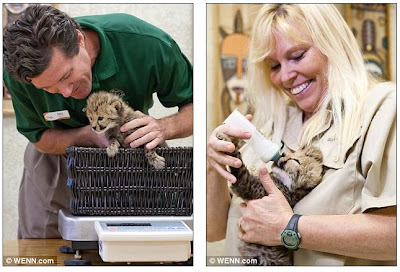 Curious and hungry: The cheetah cub is being cared for round-the clock care by animal experts
Now, at just over two pounds - the weight of two bags of sugar - the cub is becoming stronger everyday.
The animal has already melted hearts at the theme park and once the baby is strong and old enough, he will join a group of cheetahs in a new habitat that will soon open at the park which brings guests face to face with the cats.
The cub is also likely to be part of a cheetah breeding program which is aimed at boosting the population of these critically-endangered animals.
There are estimated 12,400 cheetahs living in the wild. Cheetah Run is an area of the park specifically set up for the cheetah with a 250ft run for the fast cats to run free on.
Raw Video: Baby Cheetah Squeaks, Scrambles
source: dailymail
Posted in
cheetahs,
News update
By CHRIS LEADBEATER and SARAH GORDON

Keeping up with mum: The baby cheetahs try to follow their mother up the acacia tree
And she has every reason to be watchful. While the cheetah is the fastest mammal on the planet, the initial months of the average cub's existence are fraught with danger. The animal relies on its speed for survival as well as sustenance - and the first few weeks of life, when cubs lack the power that will make them lethal predators once they reach adulthood, are extremely difficult.
Around 90 per cent of cheetahs are killed during this time, their size and diminutive stature leaving them vulnerable to attack from larger African predators, including lions, hyenas and leopards.
Still covered in their baby fluff and balancing on legs that seem too long for their bodies, these young cubs look to be a long way from joining the ranks of adult cheetahs.
But that doesn't stop them wanting to be just like mum.
Spotted outside the Kicheche Camp in Kenya's Masai Mara, the six balls of fledgling fur attempt to follow their mother up an acacia tree as she looks out over the plains.

Long way up: The more timid cubs attempt to join their siblings at the top of the tree
The species is deemed to be endangered. Estimates suggest some 12,500 cheetahs are alive in the wild, spread across 25 African countries. Namibia has the densest population - the southern African state is believed to be home to around 2500 of the cats.
Still, this sibling sextet does not seem to be doing too badly, as these exclusive photos show - even if the feline art of climbing a tree seems to come easier to some than it does to others.
 The view's great from up here: Once balanced in among the branches, the young cheetahs look quite at home
While one youngster makes it halfway up the trunk, finds a crook in a branch - and refuses to give up his hard-won spot - another cuts his losses and springs back to the ground.
Meanwhile, what appears to be the smallest club waits contentedly below the tree, showing no concern about trying to keep up with his adventurous siblings, preferring the view from ground level.
 Leap of faith: Lower down the tree, the other cubs are struggling to cling on
Another, meanwhile, makes it all the way to the top of the tree, finding the position furthest removed from potential threat - but also risks the wrath of mum by placing himself right under her feet as she continues her lonely sentry role.
Although the cubs look ungainly here, cheetahs are among the most agile creatures on earth, able to reach speeds of up to 75 miles per hour - faster than the UK speed limit, and any other land animal.
In peak condition, they can accelerate from a standing start to 60 miles per hour in three seconds.
 That's enough of that: One of the cubs bails out
They are also among the most elusive of the wild big cats - and can be particularly tricky to spot when they are protecting their young. Moreover, they are rarely seen climbing trees.
But lucky guests at the luxury tented Kicheche Camp, on the borders of the Masai Mara Reserve, were treated to this rare display earlier this month, as the cubs took advantage of their mum's rare foray into the branches to have a go at scampering up and down the acacia themselves.
 Trunk call: One of the cheetah cubs finds a lofty viewpoint, and digs in
"Cheetahs seldom climb trees, leaving clambering to leopards with their sharper claws," explains Kicheche's Paul Goldstein, who took the images.
"But for youngsters of three months, acacia trees are leisure centres, and these six lost little time in frolicking up and down its trunk.

We preferred it up there, mum: The cubs return to solid ground - but seem to prefer the safety of the branches
"But the mother has a worrying time ahead of her. Bringing up a brood of cheetah cubs is one of the toughest tasks on the plains. And seldom successful."
For more information on Kicheche Mara Camp, see www.kicheche.com.
Safari Consultants (01787 888 590, www.safari-consultants.co.uk) offers seven nights at Kicheche Mara Camp from £2,560 per adult and £1,490 per child (based on two adults and one or two children aged 12 or under sharing a tent - including flights, transfers, all meals, game viewing and park fees.
source : dailymail
Posted in
cheetahs,
News update
By DAILY MAIL REPORTER

A cheetah with her six cubs in Massai Mara National Reserve, Kenya, all in a row
With six hungry mouths to feed, there’s only one thing a mother can do – teach the kids to get their own tea.
This cheetah and her unusually large family seem to be making good progress on the self-catering front, even if the playful cubs sometimes forget hunting duty for a spot of rough and tumble instead.
Barely 10 per cent of cheetah cubs make it past three months in the wild, so at a sleek four months, these youngsters have already beaten the harshest of odds.
And they are a real credit to their mother’s ingenuity and dedication. As well as teaching them to hunt, she has to keep them hidden from predators, frequently changing hiding places to keep their enemies guessing.
Then she has to put up with their rather boisterous behaviour – six times over. But the family photos, taken in Masai Mara National Reserve, Kenya, show she is managing beautifully so far.
A spokesman for the Cheetah Conservation Fund was delighted that such an endangered species is doing so well. She said: ‘It fills us with hope that a mother can successfully look after numbers like this.’
 UP HERE! The cheetah led her brood up a tree for a better look at the beautiful surroundings
 She no doubt has her paws full with the rambunctious brood
But she’ll have her paws full for some time.
Cheetah cubs don’t leave their mothers until they are 18 months old.
Captured on camera in October in the Massai Mara National Reserve, Kenya, by Italian wildlife photographer Paolo Torchio the little ones pestering their dedicated mum - just like excitable school kids running around the feet of a human parent.
 The mum didn't have much time to prepare for her six-fold blessing. Cheetah pregnancies only last about three months
 There was no father cheetah in site as the cubs dashed about with their mum close by
Their rough-and-tumble approach to play will equip them with the skills they'll need when they mature, so they can cope with a life in the big wide world and hunt successfully.
Patricia Tricorache from international charity Cheetah Conservation Fund, said: 'It's an extraordinary and rare achievement to successfully rear a litter of this size, and great news for the species.'
For more stunning cheetah photos, visit the BBC Wildlife Magazine website at www.bbcwildlifemagazine.com
 These two cubs enjoyed a playful sibling wrestling match
 Cheetahs are easily distinguished from leopards by the black tear lines under their eyes
 The seven beautiful cats took a break from playing and enjoyed a peaceful sunset together
source: dailymail
Posted in
cheetahs,
News update

This photo provided by the San Diego Zoo shows Kiburi, a 10-day-old cheetah cub, after he opened his eyes, Wednesday, Nov. 24, 2010, at the San Diego Zoo Safari Park's Animal Care Center.
He took in the world, gobbled down a bottle, played for a little while, and then went back fast asleep in the window of the nursery.
source: Daylife
photo: AP photo
Posted in
cheetahs,
News update
By JONATHAN SCOTT

Taking a stroll: A Nomadic tribesman walks side by side in the company of a cheetah that he has helped to tame
A Nomadic tribesman of the San people strides across the hot Kalahari Desert — in the company of a cheetah he has helped to tame. Though they’re killers in the wild, these big cats are surprisingly easy to domesticate.
The animals in these striking pictures, taken in the Naankuse Wildlife Sanctuary in Namibia, were hand-reared from cubs after their mother was shot by poachers five years ago.
As a result, the three cheetahs — a male and two females — are happy to trot next to their handlers, men from the San tribe, on their daily three-hour walk across the desert.
 Fast learner: A cheetah picks up tips from a Bushman on how to hunt in the grasses that fringe the desert
After stretching their legs, the cats — who can run 100 metres in 4.5 seconds — even play ‘fetch’ when the tribesmen throw bits of rope for them to chase.
The cheetahs are so tame you can tickle them under the chin, and they drink water from the sinks at the home of 35-year-old Marlice Van Vuuren, who set up the sanctuary in 2007.
 Walkies: A tribesman and an orphaned cheetah take an evening stroll together
She now lives there full-time with a team of helpers and employs around 20 tribesmen to help care for a range of rescued and orphaned animals, including lions, leopards, wild dogs and baboons.
As babies, the cheetahs snuggled up in homemade sleeping bags and played with toy mice. Now they’re adults, they still come into Marlice’s house to watch daytime TV — before going off to hunt at night.
 Extraordinary harmony: The cheetahs are so tame that you can tickle them under the chin, and they even play 'fetch'
 Endangered species: Both the cheetah and the San tribespeople of Namibia are dwindling in numbers, but perhaps they can help each to survive in a hostile environment
Tragically, the cats are an endangered species with only 12,000 to 15,000 left in the wild. The San tribe — once known as Kalahari Bushmen — who care for these orphans, are endangered too, with fewer than 35,000 left in Namibia.
No one knows how long the cheetahs or the San people can exist in this wild landscape. But for now, they live in extraordinary harmony.
source: dailymail
Posted in
cheetahs,
News update
 Just the two of us: Kali the cheetah and puppy, Mtani have become close friends
 Kali attempt to get Mtani's attention, and below, succumbs to his mate's advances to play together


